Die klinische Studie von Northwell Health zu AudioNotch
Randomisierte kontrollierte Studie · Northwell Health · Otology & Neurotology (2026)
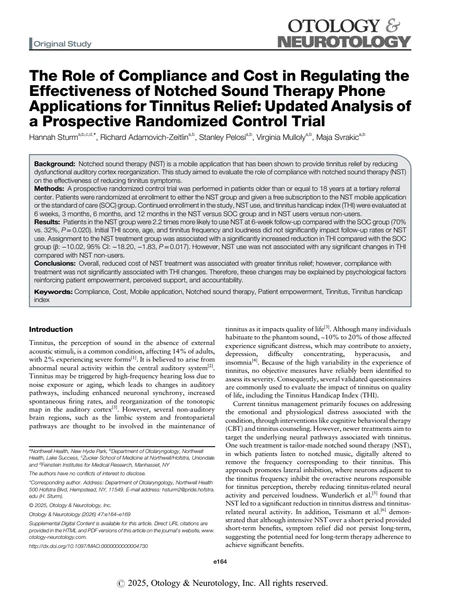
Originalstudie lesen
Forscher von Northwell Health nahmen 65 Tinnituspatienten auf, teilten sie nach dem Zufallsprinzip AudioNotch oder der Standardversorgung zu und beobachteten sie anschließend 12 Monate lang. Patienten, die AudioNotch erhielten, verbesserten sich signifikant stärker als Patienten mit Standardversorgung und hielten wesentlich häufiger an der Klangtherapie fest. Diese Seite erläutert, was die Studie ergab, wie sie durchgeführt wurde und, ebenso wichtig, was sie nicht zeigt.
Ergebnisse der Studie
Primärer Endpunkt war das Tinnitus Handicap Inventory (THI), ein validierter Fragebogen, der misst, wie stark Tinnitus das tägliche Leben beeinträchtigt. Über die 12-monatige Studiendauer war die Zuteilung zur AudioNotch-Gruppe mit einer signifikant stärkeren Senkung des THI verbunden als die Zuteilung zur Standardversorgung (lineare Regression: β −10.02, 95%-KI −18.20 bis −1.83, P=0.017). Nach 12 Monaten zeigte die AudioNotch-Gruppe eine mittlere THI-Veränderung von −9.6, während sich die Standardversorgungsgruppe um +5.0 verschlechtert hatte.
Auch die Therapietreue unterschied sich deutlich. Bei der Nachuntersuchung nach 6 Wochen nutzten noch 70% der Patienten, die AudioNotch erhalten hatten, eine Klangtherapie, gegenüber 32% in der Standardversorgungsgruppe (P=0.020), also 2.2-mal so viele. Patienten mit AudioNotch nahmen auch bei jedem Nachuntersuchungstermin häufiger weiter an der Studie teil: Nach 12 Monaten waren 93.8% der Standardversorgungsgruppe und 69.7% der AudioNotch-Gruppe für die Nachbeobachtung verloren gegangen.
Datentabelle
| Untersuchungstermin | AudioNotch | Standardversorgung | Genauigkeit |
|---|---|---|---|
| 6 Wochen | −7.8 | −0.1 | ungefähr (Abbildung 2) |
| 3 Monate | −11.2 | −4.4 | ungefähr (Abbildung 2) |
| 6 Monate | −17.8 | −2.0 | ungefähr (Abbildung 2) |
| 12 Monate. | −9.6 | +5.0 | exakt (Artikeltext) |
Durchführung der Studie
Die Studie lief von September 2019 bis Mai 2023 in der neurotologischen Praxis der HNO-Abteilung von Northwell Health und wurde vom Institutional Review Board von Northwell Health genehmigt (IRB 25-0171). Erwachsene mit subjektivem Tinnitus wurden mithilfe institutioneller Randomisierungssoftware zufällig zugeteilt: Die Behandlungsgruppe erhielt ein kostenloses AudioNotch-Abonnement, während die Standardversorgungsgruppe eine gefilterte Klangtherapie nutzen konnte, diese jedoch selbst bezahlen musste. Beide Gruppen füllten nach 6 Wochen, 3 Monaten, 6 Monaten und 12 Monaten das THI aus und berichteten über ihre Nutzung der Klangtherapie.
Eine vorläufige Analyse derselben Studie wurde 2023 veröffentlicht und umfasste die Ergebnisse bis 3 Monate; zu diesem frühen Zeitpunkt bestand kein signifikanter Unterschied zwischen den Gruppen bei der THI-Veränderung. Die aktualisierte Analyse von 2026, die die erweiterte Gruppe und die vollständige 12-monatige Nachbeobachtung umfasst, ist der maßgebliche Bericht und die Quelle aller Zahlen auf dieser Seite.
Was die Studie nicht zeigt
Die Verbesserung hing nicht von der Hördauer ab. Die angegebene Nutzung der gefilterten Klangtherapie war nicht mit der THI-Veränderung verbunden (β 1.50, 95%-KI −6.89 bis 9.88, P=0.72). Anders gesagt zeigt diese Studie, dass die Bereitstellung von AudioNotch hilfreich war, aber nicht, dass der Filtermechanismus selbst die Verbesserung verursachte. Die Autoren führen den Nutzen auf die Beseitigung der Kostenhürde sowie auf psychologische Faktoren zurück: Selbstbestimmung, wahrgenommene Unterstützung und Verbindlichkeit.
Weitere von den Autoren genannte Einschränkungen: Bei späteren Terminen schieden viele Teilnehmer aus (insbesondere in der Standardversorgungsgruppe), nur wenige Patienten erreichten die vorgeschriebenen 2 Hörstunden pro Tag, die Nutzung wurde selbst angegeben, und die endgültige Stichprobe (33 und 32 pro Gruppe) lag knapp unter den laut Poweranalyse erforderlichen 38 pro Gruppe.
Unsere ehrliche Einschätzung lautet: Eine randomisierte Studie ergab, dass Patienten, die AudioNotch erhielten, über ein volles Jahr deutlich bessere Ergebnisse erzielten als Patienten, die es nicht erhielten, und dass die aktive Teilnahme an einer strukturierten Therapie neben dem Klang selbst von Bedeutung zu sein scheint. Das ist ein echtes, nützliches Ergebnis. Es ist kein Beweis dafür, dass gefilterte Klangtherapie Tinnitus heilt, und niemand sollte sie als Heilmittel verkaufen.
Die breitere Evidenz zur gefilterten Klangtherapie
In der Northwell-Studie wurde AudioNotch als Produkt untersucht. Andere Forschungsarbeiten haben den Ansatz der gefilterten Klangtherapie selbst mit gemischten Ergebnissen untersucht:
- Okamoto et al. (2010, PNAS) und Teismann et al. (2011, PLOS ONE) stellten nach einem Training mit individuell gefilterter Musik eine Verringerung der Tinnituslautstärke und der tinnitusbezogenen Hirnaktivität fest.
- Lugli et al. (2009) berichteten von einer Verringerung der wahrgenommenen Tinnituslautstärke durch gefiltertes („windowed“) weißes Rauschen.
- Stein et al. (2016, BMC Neurology), eine randomisierte Studie mit 100 Teilnehmern zu gefilterter Musik, stellte keine signifikante Wirkung auf die primären Endpunkte fest.
- Tong et al. (2023, Ear and Hearing), eine randomisierte Studie mit 120 Teilnehmern, stellte fest, dass ein Training mit individuell gefilterter Musik bei chronischem Tinnitus wirksam war und einfachere Abläufe sowie eine bessere Therapietreue als die Tinnitus-Retraining-Therapie bot.
- Metaanalysen widersprechen einander, und Gesamtübersichten zur Klangtherapie bei Tinnitus bewerten die Evidenz als wenig verlässlich. Die Ergebnisse unterscheiden sich von Person zu Person, und manche Menschen bemerken keinen Nutzen.
Genau wegen dieser gemischten Ergebnisse bietet AudioNotch eine bedingungslose 30-Tage-Geld-zurück-Garantie, und deshalb versprechen wir kein bestimmtes Ergebnis.
Quellenangabe
Originalstudie lesen (PDF) (wird in einem neuen Tab geöffnet) · doi:10.1097/MAO.0000000000004730 · PubMed · Autorenexemplar (ResearchGate)
Vorläufige Analyse: Adamovich-Zeitlin R, et al. Otology & Neurotology, 2023. PubMed 36624601.
Unabhängigkeit und Offenlegung: Diese Studie wurde von Forschern von Northwell Health konzipiert, durchgeführt, analysiert und veröffentlicht. AudioNotch stellte der Behandlungsgruppe kostenlose Studienabonnements bereit und war weder an der Konzeption noch an der Analyse oder Veröffentlichung beteiligt. Northwell Health und die Autoren sprechen keine Empfehlung für AudioNotch aus. Die Informationen auf dieser Seite sind keine medizinische Beratung; wenn Sie Tinnitus haben, sprechen Sie zuerst mit einem Arzt.