Veelgestelde vragen over tinnitusbehandeling
Disclaimer: de volgende informatie is geen professioneel medisch advies en wordt uitsluitend ter informatie verstrekt. Raadpleeg een arts als u tinnitus heeft.
Hieronder vindt u een handleiding over de software van AudioNotch en hoe deze u kan helpen uw tinnitustoon te verminderen.
Inhoudsopgave
Wat is oorsuizen?
Tinnitus is de waarneming van geluid zonder externe geluidsbron. Het treft miljoenen mensen wereldwijd en manifesteert zich als een aanhoudend piepen in de oren. (8) Het wordt doorgaans veroorzaakt door lawaaigerelateerd gehoorverlies en veroorzaakt vaak veel leed bij vele personen. (4,5,6). Huidig bewijs wijst erop dat het optreedt door een reorganisatie van de verbindingen in de hersenen als reactie op het gedeeltelijke verlies van auditieve input van de oren. (7,9,10)
Wat is geluidstherapie met notch-filter?
Notched Sound Therapy is een tinnitusbehandeling die het volume van uw tinnitustoon kan verlagen. Ontwikkeld door onderzoekers wereldwijd, kent het twee brede vormen: Notched Music, of Notched White Noise.
Het wordt gemaakt door muziek of "witte ruis" te nemen en geluidsenergie te verwijderen—"uit te notchen"—op dezelfde frequentie als uw tinnitustoon. (2) Notched Sound Therapy is afgestemd op uw specifieke tinnitusfrequentie. Onderzoekers veronderstellen dat het de auditieve neuronen onderdrukt die uw tinnitus veroorzaken, waardoor hun activiteit vermindert. (2)
Samengevat is Notched Sound Therapy simpelweg audio die op een specifieke manier is verwerkt.
Langdurig luisteren naar deze therapie kan het volume van uw tinnitus verlagen en het aanzienlijke lijden verlichten dat door deze verschrikkelijke aandoening wordt veroorzaakt. (1,2,3) Het is ontworpen als een langetermijnbehandeling gedurende meerdere maanden, maar u zult waarschijnlijk al binnen enkele dagen na aanvang van de behandeling een vermindering van het tinnitusvolume opmerken. (3)
Notched Sound Therapy is ontwikkeld voor mensen met tinnitus die is ontstaan door gehoorverlies. Als u tinnitus heeft, raadpleeg dan eerst uw arts en ondergaat een volledig medisch onderzoek.
Wat zijn de mogelijke voordelen van het luisteren naar geluidstherapie met notch-filter?
Voor de meeste gebruikers is het belangrijkste voordeel van Notched Sound Therapy een mogelijke vermindering van het volume van hun tinnitus. Hieronder hebben wij een samenvatting gegeven van een deel van het onderzoek dat op dit gebied is uitgevoerd.
Notched Sound Therapy kent twee varianten: Notched White Noise en Notched Music. Notched White Noise Experiment, Italië
43 personen werden gerekruteerd voor een experiment om de werkzaamheid van Tailor-Made Notched White Noise te testen, waarbij zij dagelijks luisterden gedurende 12 maanden. Bij 4 van de 20 gebruikers die de behandeling ontvingen, verdwenen de tinnitustonen volledig. De gemiddelde vermindering van het tinnitusvolume in de behandelgroep was ongeveer 12 dB, oftewel een 75% volumevermindering.
Onderzoekspaper #2 — Okamoto, Stracke en Pantev (University of Muenster, Duitsland, 2010): Aangepaste notched muziektraining vermindert tinnitusvolume Onderzoeksregio: Duitsland
Deelnemers luisterden dagelijks 2 uur naar op maat gemaakte notch-muziek (Tailor-Made Notched Music) gedurende 12 maanden, wat resulteerde in een gemiddelde vermindering van 26,1% in tinnitusvolume.
Onderzoekspaper #2 — Okamoto, Stracke en Pantev (University of Muenster, Duitsland, 2010): Aangepaste notched muziektraining vermindert tinnitusvolume Onderzoeksregio: Duitsland
24 gebruikers met chronische tinnitus en minder dan 50 dB gehoorverlies werden geworven om 5 dagen lang 6 uur per dag te luisteren naar op maat gemaakte notch-muziektherapie (Tailor-Made Notched Music Therapy). 3 uur na het voltooien van slechts vijf dagen therapie was het tinnitusvolume met ongeveer 20% afgenomen, en 31 dagen later bleef het met ongeveer 10% verminderd. Dit effect werd alleen waargenomen bij notch-muziek toegepast bij gebruikers met een tinnitusfrequentie onder 8.000 Hz. Voor notch-muziek werd vastgesteld dat de tinnitusfrequentie van de gebruiker onder 8.000 Hz (8 kHz) moet liggen om de therapie te laten werken.
Onderzoekspaper #2 — Okamoto, Stracke en Pantev (University of Muenster, Duitsland, 2010): Aangepaste notched muziektraining vermindert tinnitusvolume Onderzoeksregio: Duitsland
Het oorspronkelijke Duitse team dat de op maat gemaakte notch-muziektherapie (Tailor-Made Notched Music Therapy) heeft ontwikkeld, nam 100 gebruikers op in een proef om de werkzaamheid van deze behandeling te evalueren. Na een periode van drie maanden bleek het tinnitusvolume te zijn afgenomen in de behandelingsgroep. De afname in volume was klein, maar hield aan tot een maand na het stoppen van de therapie.
Er is ook aanvullend onderzoek gedaan naar Notched Sound Therapy, dat wij in een blogpost hier hebben samengevat.
Op dit moment is er onvoldoende bewijs om het routinematige gebruik van een specifieke geluidstherapie voor tinnitus te ondersteunen. Omdat Notched Sound Therapy een actief onderzoeksgebied is, kan AudioNotch geen specifieke volumevermindering garanderen.
Wat zijn de mogelijke risico's van het luisteren naar geluidstherapie met notch-filter?
Luisteren naar audio op een onveilig volume kan gehoorverlies veroorzaken, maar dat risico geldt voor alle geluidsblootstelling en is niet uniek voor het luisteren naar Notched Sound Therapy.
In een experiment waarin notch-muziek werd getest op ongeveer 100 deelnemers, vroegen onderzoekers de deelnemers naar mogelijke nadelige effecten van het luisteren naar audio waaruit frequenties zijn verwijderd. Na drie maanden luisteren naar notch-muziek (in de experimentele groep) of gewone muziek (in de placebogroep) werd aan de deelnemers gevraagd om eventuele negatieve effecten te melden.
Er was geen statistisch significant verschil in bijwerkingen tussen degenen die naar notch-muziek luisterden en degenen die naar gewone muziek luisterden, wat erop lijkt te wijzen dat de risico's van het luisteren naar muziek waaruit frequenties zijn verwijderd gelijk zijn aan de risico's van het luisteren naar muziek in het algemeen.
Personen met tinnitus zijn hoogstwaarschijnlijk gewoon gevoeliger voor geluiden in het algemeen, wat niet verrassend is gezien het feit dat veel personen met tinnitus ook een gelijktijdig element van hyperacusis (gevoeligheid voor geluid) hebben.
Van alle deelnemers die een vragenlijst over bijwerkingen invulden (d.w.z. zowel degenen die naar notch-muziek als degenen die naar gewone muziek luisterden, n = 92), waren de belangrijkste gemelde problemen:
- een aanhoudend luidere tinnitus (10,9 %),
- de waarneming van een extra geluid (8,7 %), en
- een verhoogd bewustzijn van het tinnitusgeluid (6,5 %).
Gebruikers van Notched Sound Therapy kunnen de hierboven genoemde problemen ervaren. Veranderingen in de frequentie en/of het volume van de tinnitustoon kunnen ook leiden tot psychologische stress (merk op dat er geen statistisch significant verschil was in psychologische stress tussen degenen die naar reguliere muziek luisterden en degenen die naar notched muziek luisterden).
Wat als luisteren naar Notched Sound Therapy het volume van iemands tinnitus tijdelijk verhoogt?Wat is AudioNotch?
AudioNotch is volledig geautomatiseerde software waarmee u uw eigen Notched Sound Therapy kunt maken en ernaar kunt luisteren. Hoewel het mogelijk is om audio met andere software te verwerken om Notched Sound Therapy te creëren, maakt AudioNotch dit proces eenvoudiger en gemakkelijker. De software van AudioNotch is online beschikbaar via onze webapplicatie en ook als mobiele app voor iOS- en Android-smartphones.
Hoe gebruik ik AudioNotch?

Stap 1: Afstemmen
Gebruik onze tuner om de frequentie van de toon van uw oorsuizen te vinden. Deze zal gebruikt worden om aangepaste geluidstherapie te maken.
Probeer het hier (geen account vereist)
Heeft u hulp nodig bij het bepalen van de toonhoogte van uw tinnitus? Bekijk onze gedetailleerde Afstemmingsgids voor tips en technieken.

Stap 2: Aanmaken
Upload uw favoriete muziek, of gebruik onze geluiden. AudioNotch verwerkt vervolgens de geluiden om voor u aangepaste geluidstherapie te maken.

Stap 3: Luisteren
Luister gemiddeld 1 uur per dag naar uw geluidstherapie. U zult na verschillende dagen behandeling een verbetering van uw oorsuizen bemerken en het volume zal met verloop van tijd verder afnemen. U kunt een mp3 muziekspeler of uw computer gebruiken om naar de therapie te luisteren.
Om AudioNotch in actie te zien, ga dan naar het onderstaande filmpje:
Webapplicatie
Mobiele applicatie
Hoe verwijder ik oude nummers?
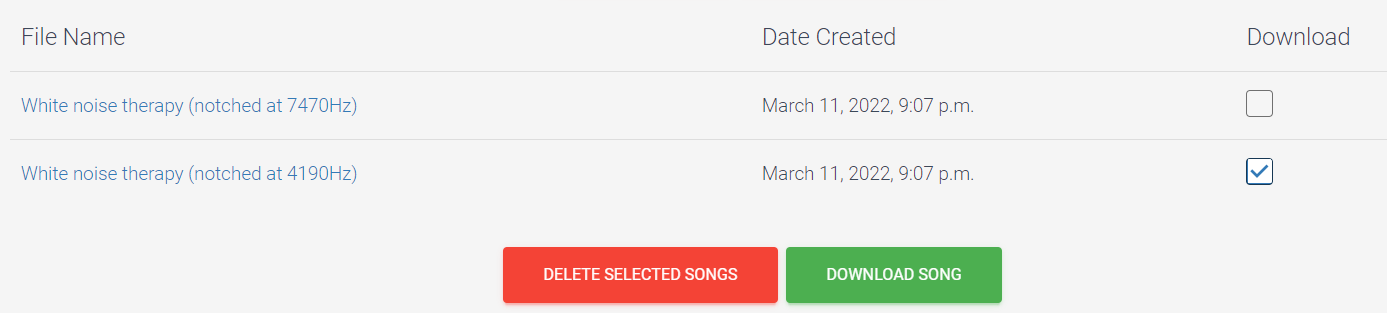
U kunt oude nummers verwijderen via de website hier: audionotch.com/app/listen/. Dit kan niet worden gedaan via de mobiele app.
Selecteer de selectievakjes van de nummers die u wilt verwijderen en klik vervolgens op de knop "Delete Selected Songs" onderaan.
Hoe verwijder ik oude tonen?
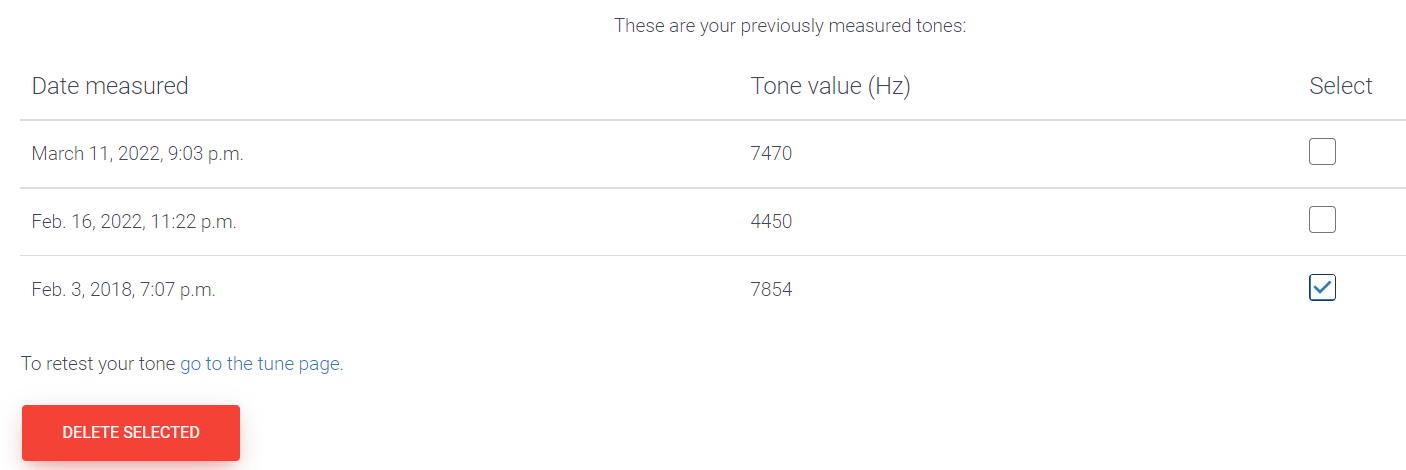
U kunt oude tonen verwijderen via de website hier: audionotch.com/app/. Dit kan niet worden gedaan via de mobiele app.
Selecteer de selectievakjes van de items die u wilt verwijderen en klik vervolgens op de knop "Delete Selected" onderaan.
Kan aangepaste auditieve destimulatietherapie mij helpen?
Als u tinnitus heeft, raadpleeg dan eerst een arts. Uw tinnitus vereist mogelijk nader onderzoek en behandeling door een arts.
Notched Sound Therapy kent twee varianten: Notched White Noise en Notched Music. Notched White Noise Experiment, Italië
In dit experiment hadden de personen in de behandelingsgroep (n = 20) de volgende kenmerken:
- De leeftijden varieerden van 25 tot 75 jaar, met een gemiddelde leeftijd van 49,3
- 14 van hen waren mannen en 6 waren vrouwen
- Het maximale gehoorverlies varieerde van 10 tot 100 dB, met een gemiddeld maximaal gehoorverlies van 55 dB
- De duur van de tinnitus varieerde van 0,25 tot 15 jaar, met een gemiddelde van 4,3 jaar
- De tinnitusfrequentie varieerde van 1 tot 13 kHz (één kHz = 1.000 Hz), met een gemiddelde tinnitusfrequentie van 7,5 kHz
- Het tinnitusvolume varieerde van 2 tot 42 dB, met een gemiddeld volume van 18,4 dB
- De tinnitustonen waren niet noodzakelijkerwijs "zuivere tonen" (een piep- of fluitgeluid) – deelnemers hadden ook de mogelijkheid om hun toon af te stemmen op een smalbandig ruistoon
Samengevat kan Notched White Noise nuttig zijn als:
- U bent 18 jaar of ouder
- U heeft een matig of minder gehoorverlies in het gebied van uw tinnitus (55 dB)
- U kunt de toon van uw tinnitus ten minste bij benadering bepalen met onze gratis stemtool
- U bent van plan één dominante tinnitustoon te behandelen
Laten we nu de profielen bekijken van de deelnemers aan het notch-muziekexperiment dat in Duitsland is uitgevoerd.
- (i) Chronische (≥ 3 maanden), tonale (d.w.z. piep- of fluitachtige) tinnitus met (ii) dominante tinnitusfrequenties tussen 1 en 12 kHz, en (iii) zonder gehoorverlies boven 70 dB HL in de frequentiebereiken van een halve octaaf boven en onder de tinnitusfrequentie. Bij bilaterale tinnitus mocht de dominante tinnitusfrequentie volgens de rapportages van de deelnemers niet verschillen tussen de oren.
- Leeftijd tussen 18 en 70 jaar.
Een andere studie leek aan te geven dat notch-muziek beter werkt voor personen met een tinnitusfrequentie onder 8 kHz, hoewel in het bovenstaande experiment deelnemers met tinnitustonen tot 12 kHz werden geworven.
Samenvattend kan notch-muziek nuttig zijn als:
- U bent 18 jaar of ouder
- U heeft minder dan 70 dB gehoorverlies in het frequentiebereik van een halve octaaf boven en onder uw tinnitusfrequentie
- U kunt de toon van uw tinnitus ten minste bij benadering bepalen met onze gratis stemtool
- U bent van plan één dominante tinnitustoon te behandelen
- Uw tinnitusfrequentie is lager dan 8.000 Hz
Wat als ik meerdere tinnitustonen heb?
Als u meerdere tinnitustonen heeft, kunt u deze naar behoefte matchen. Onze software is echter alleen ontworpen om één tinnitustoon tegelijk te behandelen.
Als u wilt, is het mogelijk om een track met meerdere notches te maken. Stel dat u twee tinnitustonen t1 en t2 heeft op twee verschillende frequenties, f1 en f2. Om een Notched Sound Therapy-bestand met meerdere notches te maken:
- Notch witte ruis op de eerste frequentie, f1.
- Download het MP3-bestand van “White Noise – Notched at f1.”
- Upload het bestand uit stap (2) als een “song.”
- Notch het nummer op f2 om een tweede notch op f2 te creëren. Nu is het bestand genotcht op f1 en f2.
- Herhaal indien nodig voor extra tinnitusfrequenties f3, f4, enz…
Hoe exact moet ik afstemmen?
Er zit enige tolerantie ingebouwd in onze procedure voor het toepassen van de notch op audio. Zolang de tinnitusfrequentie van een gebruiker binnen de breedte van de notch valt, heeft deze de tinnitusfrequentie voldoende nauwkeurig bepaald.
De breedte van de notch is eigenlijk gebaseerd op de gemiddelde frequentieselectiviteit van een persoon en bedraagt twee equivalente rechthoekige bandbreedtes (ERB).
De ERB is afhankelijk van de frequentie. Als uw tinnitusfrequentie dus 10.000 Hz (10 kHz) is, is de ERB ongeveer 1.000 Hz, wat betekent dat u binnen 1.000 Hz van uw werkelijke tinnitusfrequentie moet komen (ERB = 107,94*f + 24,7 = 107,94*10 + 24,7 = 1.104 Hz).
Sommige mensen merken een (kleine) onmiddellijke daling van het volume van hun tinnitus op na 2 minuten luisteren naar witte ruis wanneer de therapie correct is afgestemd.
Voor een uitgebreide handleiding over het afstemmen van uw tinnitustoonhoogte, inclusief tips over octaafverwarring, atypische tinnitusgeluiden en wanneer u een audioloog moet raadplegen, bezoek onze Afstemmingsgids.
Zijn er verschillen tussen e soorten geluidstherapie?
Ja. Er zijn verschillen in bij welk type gebruikers een bepaald type Notched Sound Therapy effectief is.
Gewone aangepaste auditieve destimulatiemuziek
- Bleek te werken bij patiënten met tinnitus frequentie lager dan 8 kHz (werkt niet als tinnitus frequentie hoger is dan 8 kHz) (3)
Aangepaste auditieve destimulatie witte ruis:
- Bleek te werken bij patiënten bij wie tinnitus frequentie 1-13 kHz is (1)
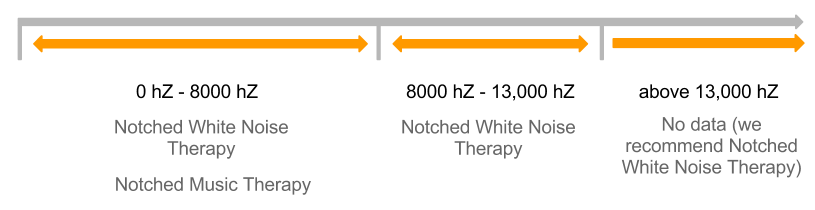
Afbeelding 3: Voorgestelde therapieën op basis van tinnitus frequenties
Auditieve destimulatie natuurlijke geluiden:
De auditieve destimulatie natuurlijke geluiden die wij bieden hebben een verschillend effectieve bereik op basis van het unieke tinnitus profiel van de gebruiker en het frequentieprofiel van het geluid. De effectieve trajecten van het geluid worden hieronder samengevat:
| Natuurlijk Geluid | Theoretische maximale effectieve frequentie |
|---|---|
| Witte Ruis | 20,000 |
| Muziek | 8,000 |
| Roze ruis | 12,600 |
| Bruine Ruis | 14,400 |
| Herstwind | 18,000 |
| Strandgolf | 15,600 |
| Stad Veger | 17,600 |
| Aanrecht | 17,800 |
| Zware Regen | 6,200 |
| Bergstroom | 17,000 |
| Zomeravond | 4,400 |
| Waterval | 16,200 |
| Waterval #2 | 16,200 |
| Witte Ruis geen Hoge Frequenties | 11,700 |
| Aanrecht geen Hoge Frequenties | 14,400 |
Hoe sterk is het bewijs voor geluidstherapie met notch-filter?
Het beschikbare bewijs ten gunste van Notched Sound Therapy vindt u hier en hier.
In de afgelopen jaren zijn er meerdere nieuwere geluidstherapieën ontwikkeld, doorgaans met de intentie om ze te commercialiseren. Aangezien winstoogmerk een motivatie kan zijn die de resultaten van wetenschappelijke studies beïnvloedt, is het belangrijk om een gezonde scepsis te behouden ten aanzien van individuele nieuwere geluidstherapie-opties (er zijn er heel wat). De meeste studies op dit gebied hebben een beperkte steekproefgrootte en zijn niet gerepliceerd door onafhankelijke onderzoeksgroepen.
Niet verrassend zijn onafhankelijke academici die de nieuwere geluidstherapie-opties hebben geëvalueerd tot de volgende conclusie gekomen:
"Over het geheel genomen is er momenteel onvoldoende bewijs om het routinematige gebruik van individuele geluidstherapie-opties te ondersteunen of te weerleggen. Het is echter waarschijnlijk dat geluidstherapie gecombineerd met voorlichting en begeleiding over het algemeen nuttig is voor patiënten."
Notch-geluidstherapie (Notched Sound Therapy) omvat het identificeren van de tinnitusfrequentie van een gebruiker en vervolgens het bewerken van audio door de geluidsenergie op en rond de tinnitusfrequentie te verwijderen. Witte ruis of muziek kan worden voorzien van een notch, wat resulteert in notch-witte ruis of notch-muziek. Langdurig luisteren naar deze geluiden zou het volume van de tinnitustoon verminderen via laterale inhibitie van de tinnitus-producerende auditieve neuronen. Het werd ontwikkeld door onafhankelijke groepen Italiaanse en Duitse onderzoekers, die aanvankelijk een volumevermindering van respectievelijk 75% en 26% bereikten. Een grotere vervolgklinische proef toonde een kleinere volumevermindering met notch-muziek dan waargenomen in de eerste experimenten. Een kritische review van notch-geluidstherapie concludeerde dat er nog steeds onvoldoende bewijs is om het aan te bevelen voor standaard klinisch gebruik. Aanvullend onderzoek is hier beschikbaar.
Hoe lang duurt het voor auditieve destimulatietherapie werkt?
We hebben de grafiek van volumevermindering van Lugli, 2009 (1) gereproduceerd. Dit toont de gemiddelde volumevermindering die bij patiënten is waargenomen aan. WWN verwijst naar Witte Ruis Therapy, en de andere twee lijnen geven controle behandelingen aan (dwz non-notched witte ruis). Zoals aangetoond wordt, kan een geleidelijke volumevermindering verwacht worden, dit neemt toe met maanden therapie. xxxxxxxxxxxxxxxxxxxxxxxxxxx
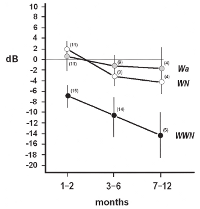
Afbeelding 4: Gemiddelde volumevermindering door auditieve destimulatietherapie (WWN) versus controle
Zijn de gevolgen blijvend?
Over het algemeen wordt aangenomen dat hoe meer uren u naar de therapie luistert en hoe meer weken u het gebruikt, hoe groter het effect zal zijn en hoe blijvender de veranderingen. (4)
Als u de therapie slechts gedurende een zeer korte, intensieve periode (een paar dagen) gebruikt, zal de volumevermindering niet blijvend zijn en zal deze waarschijnlijk na verloop van tijd volledig omkeren. (3)
Daarom is het belangrijk om meerdere maanden naar de genotchte geluiden te luisteren, zoals gebruikers deden in de experimenten met Notched Sound Therapy. Deze therapie is pas recentelijk ontdekt en er zijn nog geen meerjarige vervolgstudies bij gebruikers uitgevoerd.
Het is mogelijk dat als u volledig stopt met het gebruik van de therapie (na maanden van therapie luisteren), de vermindering van uw tinnitusvolume gedeeltelijk wordt teruggedraaid (of zelfs volledig). Gelukkig kunt u in dat geval eenvoudig opnieuw beginnen met luisteren naar de therapie en uw tinnitusvolume opnieuw verlagen.
Waarom moet ik de frequentie van mijn oorsuizen opnieuw controleren tijdens de behandeling?
In de loop van enkele maanden behandeling, is het mogelijk dat de frequentie van de tinnitus enkele keren verandert. Dit is normaal en kan veroorzaakt worden als een respons op de behandeling.
Als de 'auditieve destimulatie' NIET is afgestemd met uw tinnitus frequentie, zal de therapie NIET werken. De 'auditieve destimulatie' moet afgestemd zijn met uw tinnitus frequentie om een therapeutische voordeel te bemerken.
Daarom raden wij u aan om uw tinnitusfrequentie meerdere keren tijdens uw behandeling opnieuw te testen (met behulp van onze afstemmingsapp). Wij adviseren wekelijks testen tijdens de eerste maand van de behandeling, en daarna eenmaal per twee weken.
Om gebruikers te helpen bij het implementeren van de AudioNotch-tinnitusbehandeling hebben wij een eenvoudig aanbevolen Behandelplan aangeboden op basis van het tot nu toe beschikbare wetenschappelijke bewijs.
Waar is het wetenschappelijke bewijs?
Tinnituspatiënten moeten terecht sceptisch zijn over behandelingen die beweren tinnitus te genezen; veel van deze claims worden gedaan zonder enig wetenschappelijk bewijs. Bovendien zijn zelfs behandelingen met wetenschappelijke onderbouwing vaak gebaseerd op kleine studies die meer vervolgonderzoek vereisen.
Tailor-Made Notched Sound Therapy is gebaseerd op meerdere experimenten uitgevoerd door onafhankelijke onderzoeksgroepen. Wij moedigen onze klanten aan om het originele wetenschappelijke bewijs waarop AudioNotch is gebaseerd te bekijken. We hebben ook een link naar een kritische review van Notched Sound Therapy opgenomen. Samengevat is het bewijs voor Notched Sound Therapy voorlopig en zijn er grootschaligere studies nodig om meer definitieve conclusies over de werkzaamheid te trekken.
In de tussentijd hebben wij ernaar gestreefd om deze veelbelovende aanpak nu beschikbaar te maken voor gebruikers, in een poging hen te helpen. Voor uw gemak hebben wij hieronder links naar deze publicaties opgenomen.
AudioNotch Inc. is een onafhankelijk bedrijf en wij zijn niet gelieerd aan de wetenschappers die dit onderzoek hebben uitgevoerd.
Gewone aangepaste auditieve destimulatiemuziek:
- Customized Notched Music Training Reduces Tinnitus Loudness
- Listening to Tailor-Made Notched Music Reduces Tinnitus Loudness and Tinnitus-Related Auditory Cortex Activity
- Short and Intense Tailor-Made Notched Music Training Against Tinnitus: The Tinnitus Frequency Matters
- Clinical Trial on Tonal Tinnitus with Tailor-Made Notched Music Training
- Preliminary analysis of the effects of tailor-made notched music therapy on chronic idiopathic tinnitus.
- A Real-time Tinnitus Treatment System Using Tinnitus Frequency Removal and Adjacent Frequency Amplification on [a] Mobile Device
Varianten van notch-muziektherapie:
- Combining Transcranial Direct Current Stimulation and Tailor-Made Notched Music Training to Decrease Tinnitus-Related Distress — A Pilot Study
- Tinnitus therapy using tailor-made notched music delivered by a smartphone application and Ginko combined treatment: A pilot study
Aangepaste auditieve witte ruis:
Reviews van het vakgebied Notched Sound Therapy:
- Listening to Filtered Music as a Treatment Option for Tinnitus: A Review
- Critical Review: Efficacy of notched-sound therapy for neural plasticity mediated tinnitus treatment (unpublished)
Overzicht van geluidstherapie:
Hoe werkt het?
Raadpleeg de Hoe het Werkt sectie van onze website voor een vereenvoudigde technische uitleg van onze behandeling. De wetenschappelijke uitleg is ingewikkeld, maar we hebben geprobeerd deze om te zetten in begrijpelijke termen met gebruik van bepaalde afbeeldingen.
Voor degenen onder u met meer kennis van neurowetenschappen verwijzen wij naar de hierboven gelinkte peer-reviewed wetenschappelijke publicaties. In de sectie "Discussion" van elk artikel vindt u een technische uitleg van het voorgestelde werkingsmechanisme van onze behandeling. (1, 2)
Kort gezegd lijkt een combinatie van laterale inhibitie en daaropvolgende veranderingen in de auditieve cortex via corticale plasticiteit een rol te spelen. (2) Het selectief stimuleren van de auditieve neuronen die de tinnitusfrequentie niet produceren, lijkt de auditieve neuronen die de tinnitusfrequentie wel produceren lateraal te remmen. (2) Aanhoudende laterale inhibitie herprogrammeert de verbindingen tussen neuronen in de auditieve cortex, waardoor het basisniveau van inhibitie toeneemt (zelfs wanneer gebruikers niet naar de muziek luisteren). (2) Daardoor neemt het tinnitusvolume af.
Wat is de aanbevolen behandeling?
Het AudioNotch Behandelingsplan zorgt ervoor dat de tinnitus frequentie van een gebruiker kan verschuiven tijdens de periode van behandeling.
Daarom is het noodzakelijk om periodiek de tinnitus frequentie opnieuw detecteren ("af te stemmen") zodat de auditieve destimulatie correct past bij de tinnitus frequentie. De auditieve destimulatie moet afgestemd zijn op de tinnitus frequentie, anders werkt de therapie niet. Daarom bestaat be behandeling uit een zich herhalende cyclus:
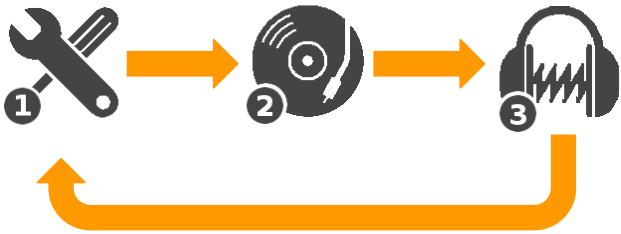
Afbeelding 4: Het aanbevolen AudioNotch behandelplan
Behandelplan: (voor Muziek of Witte Ruis)
Als u luistert, zorg dan dat u het op een comfortabel volume houdt! Luisteren op hoog volume kan uw gehoor beschadigen en uw tinnitus verergeren!
We raden aan dat u elke dag een uur naar AudioNotch luistert. Probeer het luisteren over de dag te verspreiden (d.w.z. verschillende sessies in de ochtend, middag en avond). Verhoog indien nuttig naar 2 tot 3 uur per dag.
Wij raden u aan om een koptelefoon te gebruiken die omgevingsgeluid blokkeert, zoals een koptelefoon met ruisonderdrukking of in-ear oordopjes. Over het algemeen zijn circumaurale (over-ear) koptelefoons hiervoor effectief. Als alternatief kan een koptelefoon met actieve ruisonderdrukking worden gebruikt. In-ear oordopjes kunnen ook effectief zijn, mits ze extern geluid effectief blokkeren.
Hoe luid zou de therapie moeten zijn?
Zorg er net als eerder voor dat u op een veilig volume luistert! Luisteren op hoog volume kan uw gehoor beschadigen en uw tinnitus verergeren. Luister naar de geluidstherapie op ongeveer het volume van uw tinnitus, maar overschrijd een veilig volumeniveau niet.
Wat voor soort ondersteuning biedt AudioNotch?
AudioNotch biedt ondersteuning via e-mail gedurende de looptijd van het abonnement. Doorgaans beantwoorden wij alle ondersteuningsvragen binnen één tot twee werkdagen.
Benadeelt het gebruik van mp3's de behandeling?
Nee. Hoewel AudioNotch de op maat gemaakte geluidstherapie distribueert als MPEG-3-bestanden, hebben wij ervoor gezorgd dat het geluid van de juiste kwaliteit is. Het gebruik van mp3-bestanden stelt ons in staat om het breedste scala aan afspeelapparaten te ondersteunen voor het grootste aantal tinnituspatiënten.
Vanuit een meer technisch perspectief zorgen wij ervoor dat voor gebruikers met een hoogfrequente toon (d.w.z. boven 8000 Hz) geen laagdoorlaatfiltering plaatsvindt bij de mp3-codering. Voor gebruikers met een hoogfrequente toon coderen wij ook met een hoge bitrate van 320 kbps. Op grond van de signaalverwerkingstheorie is een hogere bitrate niet nodig voor personen met een laagfrequente toon.
Moet ik in beide oren luisteren als ik tinnitus heb in één oor?
Veel mensen met unilaterale tinnitus (tinnitus in slechts één oor) schrijven ons met de vraag of zij naar AudioNotch in beide oren moeten luisteren, aangezien slechts één oor is aangedaan.
Het antwoord? Interessant genoeg moet u in beide oren luisteren, zelfs als uw tinnitus slechts in één oor zit. Het is een contra-intuïtief antwoord.
De reden is dat in de experimenten waarop de therapie is gebaseerd, mensen in beide oren werden behandeld, zelfs als zij unilaterale tinnitus (tinnitus in één oor) hadden. Deze aanpak was mogelijk effectief omdat tinnitus een fenomeen is dat optreedt in de auditieve cortex van de hersenen, en beide oren input leveren aan de auditieve cortex. De neuronen die spontaan vuren in dit gebied en daardoor de tinnitustoon produceren, kunnen nog steeds worden beïnvloed door input van het contralaterale oor.
Terugbetalingen, diensten en ondersteuning
De aankoop van een AudioNotch-programma geeft u recht op technische ondersteuning per e-mail voor hulp bij het gebruik van de AudioNotch-software (merk op dat wij geen medisch advies of evaluaties per e-mail verstrekken, alleen technische softwareondersteuning). De meeste e-mailvragen worden binnen 1-2 werkdagen beantwoord.
Wij bieden een onvoorwaardelijke 30 dagen geld-terug-garantie voor aankopen via onze website. Wij kunnen echter geen terugbetalingen verstrekken voor in-app-aankopen die via onze mobiele apps zijn gedaan.
Belangrijk: AudioNotch-abonnementen worden nooit automatisch verlengd. Wanneer uw abonnement afloopt, moet u handmatig een nieuw abonnement aanschaffen als u de dienst wilt blijven gebruiken. Dit betekent dat er nooit onverwachte kosten voor abonnementsverlengingen in rekening worden gebracht.
Hoe krijg ik een terugbetaling voor een Apple in-app aankoop?
Als u AudioNotch hebt gekocht via de Apple App Store als in-app-aankoop, kunt u een terugbetaling rechtstreeks bij Apple aanvragen. Zo doet u dat:
- Ga naar reportaproblem.apple.com en log in met uw Apple ID
- Tik of klik op "I'd like to" en kies vervolgens "Request a refund"
- Kies de reden waarom u een terugbetaling wilt en kies vervolgens Next
- Zoek de AudioNotch-app-aankoop of het abonnement en kies Submit
Apple zal uw verzoek beoordelen en reageert doorgaans binnen 24-48 uur. Indien goedgekeurd, kan het extra tijd duren voordat de terugbetaling op uw betaalmethode verschijnt.
Opmerking: Als u de aankoop niet kunt vinden op de Apple-terugbetalingswebsite, controleer dan uw e-mail op bonnen van Apple om te bevestigen welke Apple ID is gebruikt voor de aankoop. Mogelijk moet u inloggen met een andere Apple ID als u meerdere accounts heeft.
Voor meer gedetailleerde instructies, bezoek Apple's officiële ondersteuningspagina voor terugbetalingen.
Wat als luisteren naar Notched Sound Therapy het volume van iemands tinnitus tijdelijk verhoogt?
Het lijkt waarschijnlijk dat een deel van de tinnituspatiënten een gevoel van verhoogd tinnitusvolume zal ervaren bij elke langdurige blootstelling aan audio van welke aard dan ook.
Sommige gebruikers van Notched Sound Therapy ervaren een tijdelijke toename van het tinnitusvolume na het luisteren naar de therapie. Dit is direct merkbaar bij het eerste luisteren naar de geluidstherapie. Op basis van onze ervaring en analyse van de literatuur is deze toename van het tinnitusvolume tijdelijk en omkeerbaar na het stoppen van de therapie, en als het bij een persoon optreedt, gebeurt dit wanneer zij voor het eerst luisteren naar audio die is verwerkt met een notch-algoritme.
In sommige gevallen kan het luisteren naar Notched Sound Therapy het basisvolume van iemands tinnitus tijdelijk en omkeerbaar verhogen. Er zijn meerdere mogelijke verklaringen:
- Onjuiste detectie van tinnitus frequentie, wat leidt tot een "auditieve destimulatie" die de werkelijke tinnitus frequentie van de gebruiker niet overlapt.
- Luisteren naar Notched Sound Therapy op een onveilig volumeniveau, aangezien elk hard geluid tinnitus kan verergeren als het te luid is.
- Sommige gebruikers hebben hun tinnitusfrequentie correct vastgesteld en luisteren op een veilig volumeniveau, en desondanks ervaren zij een toename van het volume van hun tinnitus. Dit kan al dan niet te wijten zijn aan een auditieve illusie die bekend staat als een "Zwicker-toon", of het kan te wijten zijn aan de specifieke reactie van die persoon op het luisteren naar audio waaruit frequenties zijn verwijderd.
Als dit bij u optreedt terwijl u naar Notched Sound Therapy luistert, neem dan de volgende stappen:
- Controleer of de therapie daadwerkelijk niet werkt. Soms kan het tinnitusvolume direct na een sessie Notched Sound Therapy tijdelijk toenemen, maar kan men toch een nettovermindering van het basisvolume van de tinnitus ervaren, wat resulteert in een algehele afname van het tinnitusvolume.
- Controleer dat u uw tinnitus frequentie juist gedetecteerd heeft (zo goed als u kunt) en dat u niet naar een onveilig volume luistert.
- Als de bovenstaande stappen niet helpen, stop dan met luisteren naar Notched Sound Therapy. Na een rustperiode keert uw tinnitusvolume terug naar het normale niveau. Vraag vervolgens een terugbetaling aan per e-mail (support@audionotch.com) volgens ons normale terugbetalingsbeleid (dit beleid staat een terugbetaling binnen 30 dagen toe. Naar onze ervaring hebben alle gevallen van tijdelijke toename van het basis-tinnitusvolume zich binnen deze initiële periode voorgedaan).
De tijdelijke toename van het tinnitusvolume lijkt op te treden bij 5-10% van de gebruikers en is omkeerbaar na het stoppen van de therapie.
Referenties
- Lugli M, Romani R, Ponzi S, Bacciu S, Parmigiani S (2009) The windowed sound therapy: a new empirical approach for an effective personalized treatment of tinnitus. Int Tinnitus J 15:51-61.
- Okamoto H, Stracke H, Stoll W, Pantev C (2010) Listening to tailor-made notched music reduces tinnitus loudness and tinnitus-related auditory cortex activity. Proc Natl Acad Sci U S A 107: 1207-1210.
- Teismann, H., Okamoto, H., Pantev, C. (2011). Short and intense tailor-made notched music training against tinnitus: The tinnitus frequency matters. Plos ONE, 6, 1-8.
- Eggermont, J.J., Roberts, L.E. (2004). The neuroscience of tinnitus. Trends in neurosciences, 27, 676-82.
- Rajan, R. (1998). Receptor organ damage causes loss of cortical surround inhibition without topograhic map plasticity. Nature Neuroscience, 1, 138-143.
- Dobie RA (2003) Depression and tinnitus. Otolaryngol Clin North Am 36: 383–388.
- Jastreboff PJ (1990) Phantom auditory perception (tinnitus): mechanisms of generation and perception. Neurosci Res 8: 221–254.
- Heller AJ (2003) Classification and epidemiology of tinnitus. Otolaryngol Clin North Am 36:239–248.
- Saunders JC (2007) The role of central nervous system plasticity in tinnitus. J Commun Disord 40:313–334.
- Rauschecker JP, Leaver AM, Muhlau M (2010) Tuning out the noise: limbic-auditory interactions in tinnitus. Neuron 66: 819–826.