The strongest evidence on whether AudioNotch works is no longer our own survey data: it is a randomized controlled trial run by Northwell Health researchers (65 patients, 12-month follow-up, published in Otology & Neurotology, 2026). Patients randomly assigned to AudioNotch improved significantly more on the Tinnitus Handicap Inventory than patients assigned to standard care (β −10.02, P=0.017), and were 2.2x more likely to still be using sound therapy at 6 weeks. Improvement was not tied to hours of listening, so the researchers credit engagement and support alongside the sound itself. It is an independent study, the researchers do not endorse AudioNotch, and we keep a full plain-language breakdown, limitations included, on our research page.
The rest of this post is the customer survey data we published in 2019, kept here for transparency. Surveys are a far weaker form of evidence than a randomized trial, for the reasons listed below.
To monitor the efficacy of AudioNotch's tinnitus treatment we send two surveys at one and two month intervals after purchase. In this post we go through the results of the surveys. Please keep in mind the following:
The percentages are not statistically representative of the actual results that exist: fewer than 10% of our active user base responds to the surveys
We have about a 3% refund rate right now. Thus we believe that those who have a negative experience with AudioNotch would be more likely to respond to a survey resulting in a higher percentage of negative responses.
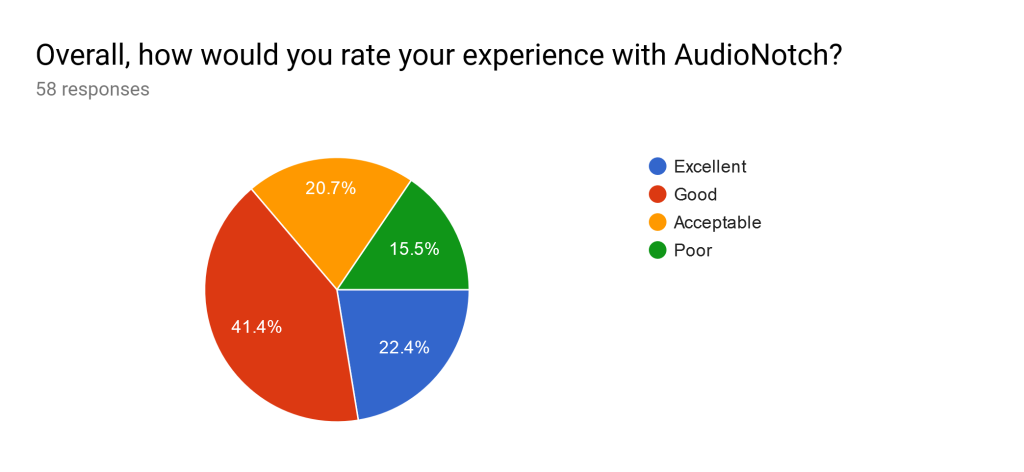
Here we see that 63.8% of survey respondents rate their experience with AudioNotch as Good or Excellent.
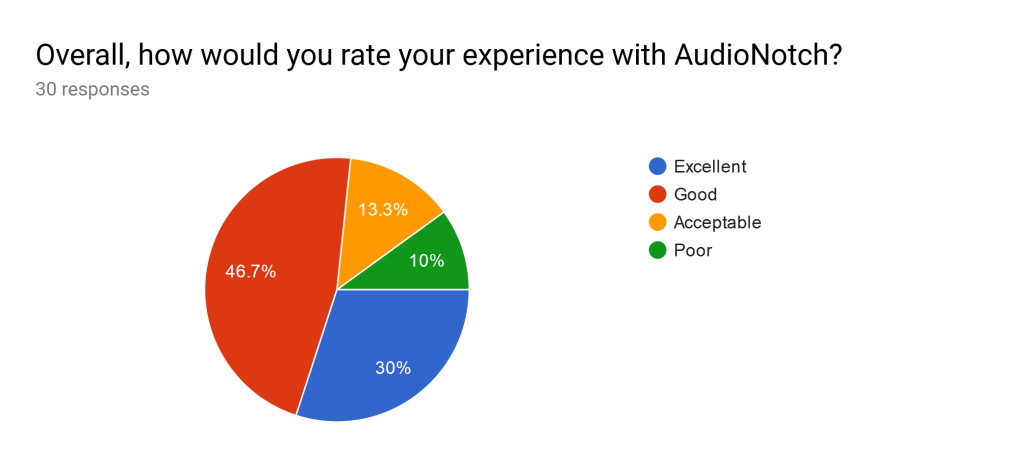
Overall satisfaction - Two Months
After two months we see that 76.7% of survey respondents rate their experience with AudioNotch as Good or Excellent with only 10% rating their experience as Poor.
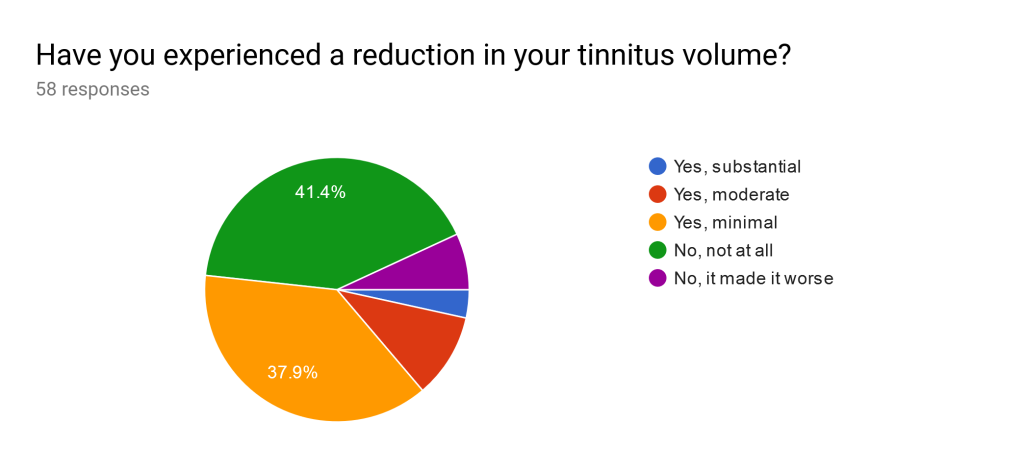
Tinnitus volume reduction - One Month
Here we see more than half of survey respondents (52%) had a reduction in the volume of the ringing in their ears. Unfortunately 4 out of the 58 respondents found that AudioNotch made things worse. This is a risk of any tinnitus sound therapy and this is why we offer a money-back guarantee.
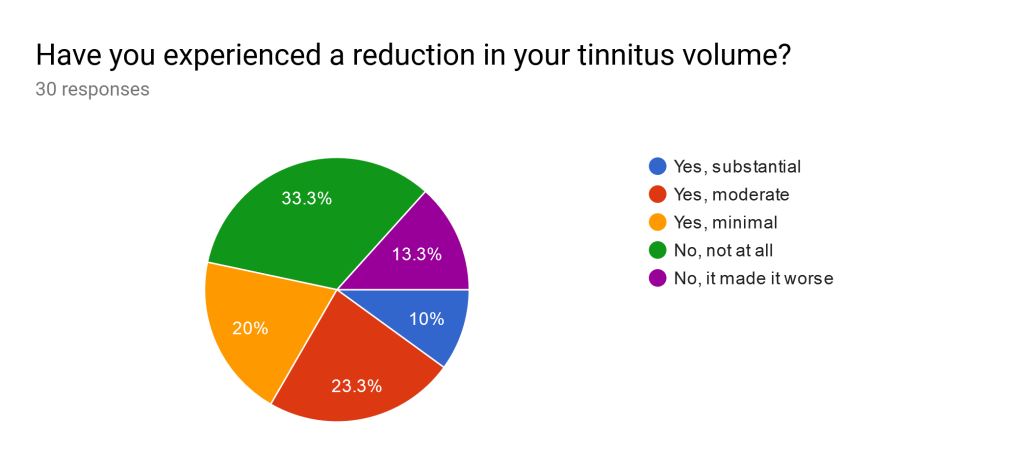
Tinnitus volume reduction - Two Months
After two months we see that the percent of people who had a significant reduction in tinnitus volume grew to 10%. 53.3% saw a reduction in volume. Unfortunately there were also 4 people who saw an increase in volume.
In follow-up blog posts we will investigate the correlation with how well survey respondents were able to find their tinnitus frequency and the results they observed.
If you have any questions about the data get in contact with us here.
If you would like to sign up for AudioNotch tinnitus treatment then you can do so here.
Wishing you all the best,
Adrian, CEO
An honest, evidence-based ranking of every major sound therapy for tinnitus -- from CBT and hearing aids to notched sound therapy, bimodal neuromodulation, TRT, and more. What works, what might work, and what probably doesn't.
If tinnitus is created by the brain rewiring itself, can we fix it by rewiring the brain back? Two decades of research into neuroplasticity-based sound therapy -- from notched sound to bimodal neuromodulation -- are starting to provide answers.
A clinical trial found that real-time fMRI neurofeedback - where patients learn to control their own brain activity - reduced tinnitus distress significantly more than cognitive behavioral therapy, with benefits that kept growing over 12 months.